
Criminal Cases in Dallas County Courts
Dallas County criminal court records split first by court. Felony criminal cases belong in Dallas County Circuit Court, where the Arkansas Courthouse Kiosk listing names felony criminal as a case type. The County/Circuit Clerk is the working record custodian for circuit-level case files, docket questions, older paper or local files, and certified copies.
Dallas County District Court, Fordyce department, is the lower-court point for district-court matters such as traffic, ordinance, fine-only, failure-to-appear, and other limited-jurisdiction cases. A reader should not assume every criminal-looking matter is a circuit felony. The court field in Search ARCourts, a citation, a jail entry, or a clerk notice usually tells which court holds the file.
Dallas County Circuit Court at Third Street
The circuit court record counter is tied to the Dallas County Courthouse in Fordyce. The court and clerk information captured in the research gives the courthouse address as 206 W. Third St., Fordyce, AR 71742, with the clerk/court phone at (870) 352-2307. That is the practical route when Search ARCourts shows only part of the docket or when the searcher needs certified copies instead of a screen result.
Source: Arkansas Judiciary Search ARCourts information
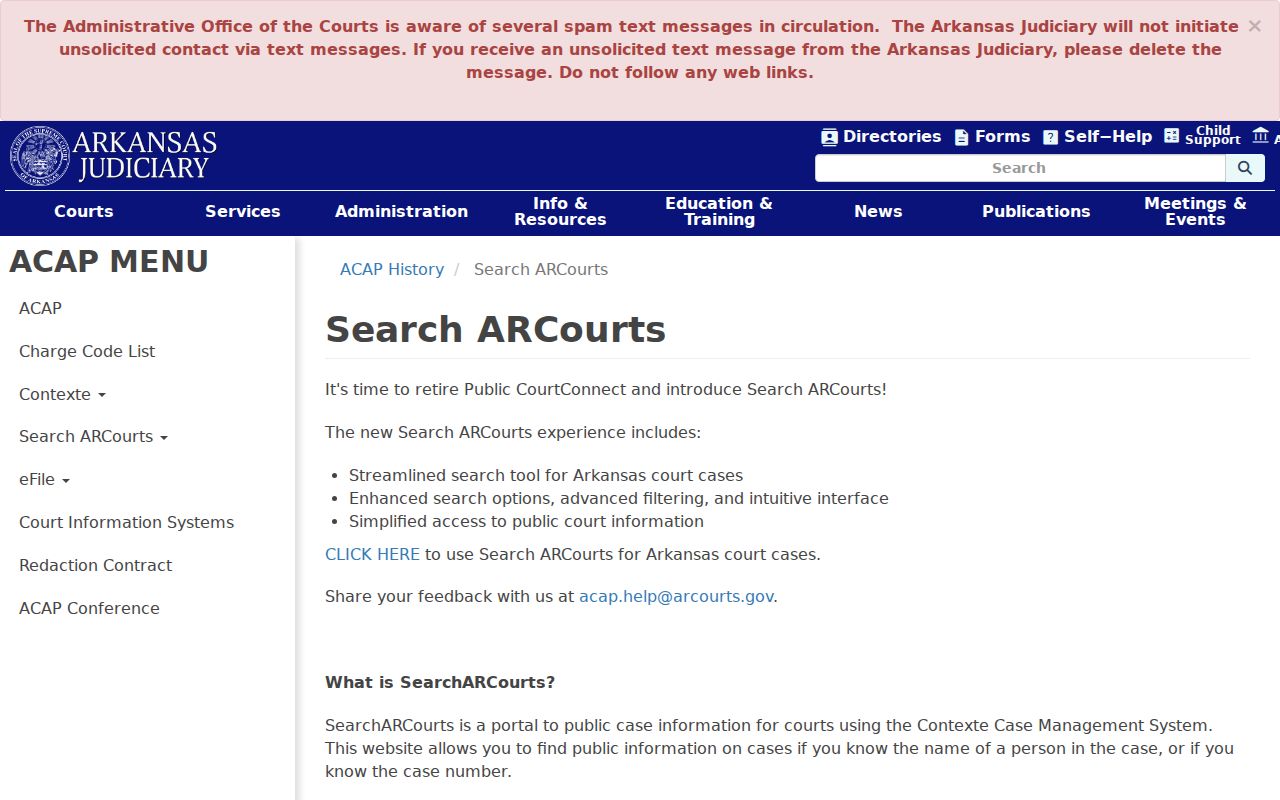
The Judiciary page explains the statewide portal and its public access limits, which is why Dallas County clerk contact still matters for complete case-file work.
District Court Records in Fordyce
The Dallas County District Court, Fordyce department, is listed by the Arkansas Judiciary as a State District Court in Judicial District 34. The mailing address is PO Box 672, Fordyce, AR 71742, with phone 870-352-2332 and fax 870-352-3414. District court is the better starting point when the issue began as a lower-level citation, traffic case, ordinance matter, payment issue, or district-court bench warrant.
District court and circuit court records can look similar to a searcher because both may involve criminal charges, missed appearances, or court costs. The distinction matters because the record custodian, case number, copy request, and warrant question may point to different offices. If a Search ARCourts result is ambiguous, read the court name before reading the charge label.
Source: Arkansas Judiciary Dallas County District Court, Fordyce department
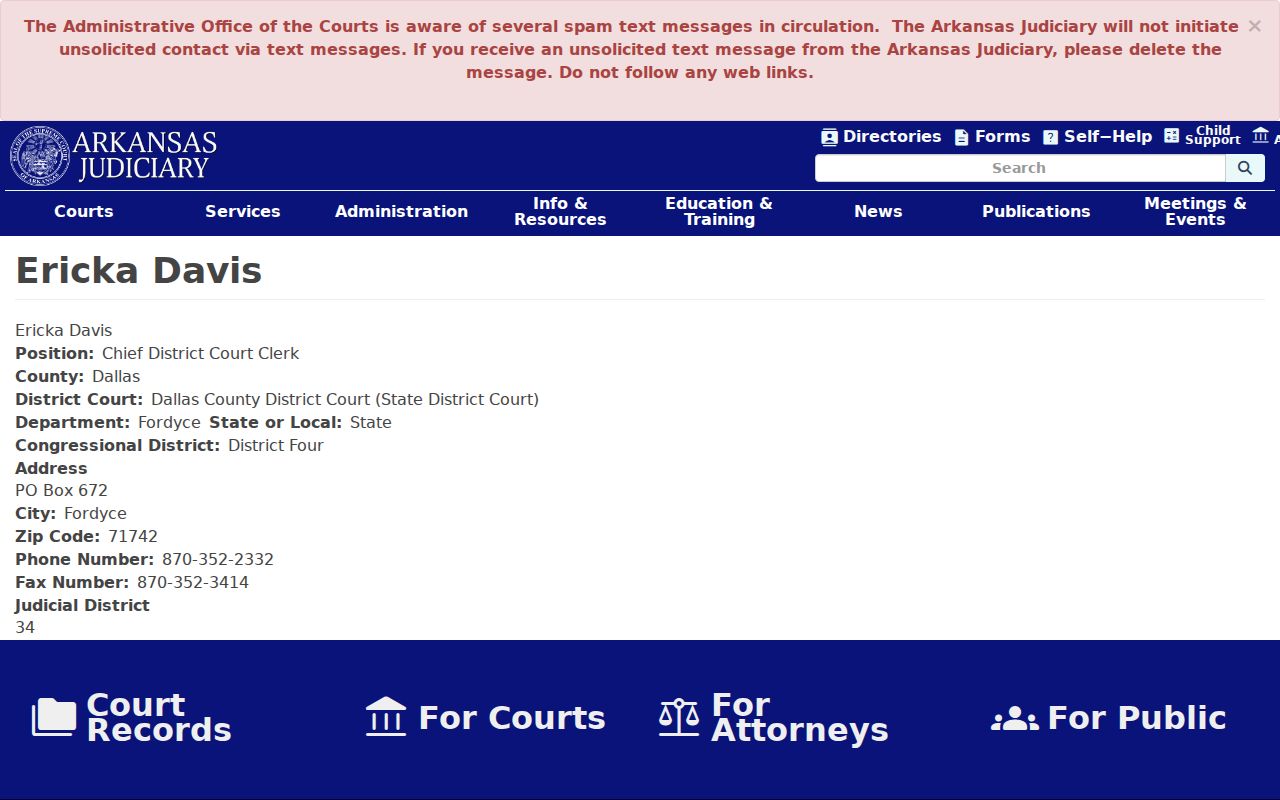
The Fordyce department page gives the district-court contact route for lower-court records that may not be handled by the circuit clerk.
How to Search Case Records
Search ARCourts is the online starting point for public case information in Arkansas courts using the Contexte Case Management System. Arkansas Judiciary describes the portal as the replacement for Public CourtConnect and says public case information may include parties, judge, filings, charges and dispositions, future events, judgments, and some document links.
- Open Search ARCourts and choose the search path that fits what you know, usually participant name first or case number if it appears on jail paperwork, a citation, or a notice.
- Enter the party name carefully, then narrow by Dallas County, court, case type, or filing period when the interface offers those filters.
- Open possible matches and read the court field before relying on the charge list, because Circuit Court and District Court records answer different questions.
- Check the docket entries, charges, disposition, future events, and judgment fields separately. A pending charge, dismissed charge, and conviction are different outcomes.
- Contact the Dallas County Circuit Clerk or Dallas County District Court for copies, certification, older files, document access, or records that appear restricted online.
| Search ARCourts Field | Type | Required | Notes |
|---|---|---|---|
| Participant or party name | Text | No single required path | Best when no case number is known; common names need Dallas County and court filters where available. |
| Case number | Text | Optional path | Use the exact number from a citation, jail record, summons, docket notice, or clerk communication. |
| Court or county | Filter | Optional where exposed | Select Dallas County or the specific court to avoid similarly named parties in other Arkansas courts. |
| Advanced filters | Filters | Optional | The Judiciary describes enhanced search and advanced filtering in the new portal. |
| Search and reset controls | Buttons | Action controls | Run the search, clear entries, and repeat with alternate spellings when needed. |
Search ARCourts Replaced CourtConnect
The Arkansas Judiciary specifically describes Search ARCourts as the modern replacement for Public CourtConnect. That transition matters in Dallas County because older instructions, saved bookmarks, and third-party references may still use the CourtConnect name. The current court-search language should point to Search ARCourts for statewide public case information.
The change also explains why a searcher may see references to the older portal in instructions that otherwise describe real Arkansas court records. Use the current portal name when asking a clerk for help, but keep any old case number, citation number, or docket notice because the underlying file may still be the same court record.
Source: Arkansas criminal-history dissemination statute
State dissemination rules are part of the reason a court search, a repository check, and a courthouse copy request can return different levels of detail.
What the Case File Shows
A Dallas County criminal case file is a court record, not the same thing as a booking entry or a state repository product. The file may show the case number, court, case type, parties, judge, filings, charge history, hearing settings, docket events, disposition, judgment, sentence, and documents when they are public and linked.
| Case Number and Court | Identifies whether the record is in Dallas County Circuit Court, Dallas County District Court, or another Arkansas court. |
|---|---|
| Parties and Judge | Shows the defendant or participant, the State of Arkansas where applicable, attorneys when public, and the judicial officer. |
| Charges | Lists charge descriptions, counts, statute or code references where displayed, and charge level if available. |
| Docket and Filings | Shows dated entries such as filings, motions, orders, notices, hearing activity, and procedural updates. |
| Disposition and Judgment | Separates pending, convicted, dismissed, nolle prosequi, acquittal, and final judgment information where public. |
| Documents and Redactions | May include linked public documents, but juvenile, sealed, confidential, victim, and sensitive identifier material can be withheld. |
Reading a Dallas County Disposition
The disposition is the outcome field, and it should be read separately from the charge name. Pending means the court has not entered a final outcome. Convicted means the court accepted a plea or entered a finding of guilt. Dismissed, nolle prosequi, acquittal, and no-bill outcomes do not mean the same thing, but each can explain why a charge does not become a conviction.
That distinction is especially important when a person first appears in the Dallas County jail roster and later appears in Search ARCourts. The jail entry records a custody event. The court file records prosecution activity and outcome. If the court file does not yet show a disposition, the case may simply be too new or not yet updated.
Stages of a Criminal Case
Dallas County case timing depends on the arrest, charging decision, court assignment, and docket activity. A very recent arrest may appear in the sheriff roster before a prosecutor files a case. Once filed, the court record can show arraignment, hearings, motions, plea or trial activity, judgment, sentencing, or future events. Some stages may be visible online, while documents or details may require clerk contact.
Case flow: Arrest › Booking › Charging decision › Court filing › Arraignment › Hearings or plea/trial › Disposition › Judgment or sentencing › Clerk copies or sealing follow-through
Certified Copies from the Clerk
Search ARCourts is a lookup channel. It is not the office that certifies a Dallas County criminal case file. For certified copies, older files, unavailable documents, or questions about whether a record is sealed or restricted, contact the custodian court. For felony and circuit-level matters, that is the County/Circuit Clerk at the courthouse. For district-court matters, call the Fordyce department.
No Dallas County online fee schedule for criminal case copies or certifications was located in the official sources inspected. Ask the clerk for the copy fee, certification fee, acceptable payment method, mailing instructions, and whether the record can be emailed, mailed, picked up, or must be reviewed in person.
Give the clerk the case number if known. If not, provide the party name, approximate filing year, charge type, and whether the case was in circuit or district court. A narrow request is easier to route and reduces the risk of paying for the wrong file.
Access and Restrictions
Arkansas public access has several layers. The Arkansas Freedom of Information Act supports inspection and copying of public records, but exempt material must be separated from nonexempt material where possible. Criminal-history dissemination rules also mean state repository information is not the same as unrestricted public access to ACIC or NCIC data. Court records have their own public-access rule through Arkansas Supreme Court Administrative Order 19.
Administrative Order 19 is the key online court limit. Search ARCourts may show basic case information while blocking or omitting juvenile material, sealed records, confidential data, victim information, protected identifiers, and documents not approved for Internet display. A missing online detail does not prove the paper file lacks that document.
Sealed Records After Court Order
Arkansas uses record sealing as the practical public-facing term for removing qualifying records from ordinary public access. ACIC provides sealing forms, including categories for felony, misdemeanor, arrest, nolle prosequi, dismissal, acquittal, charges not filed, Act 346, drug court, and other paths. The court where the record arose is the filing point for the petition and proposed order.
After a sealing order is approved and filed, the clerk forwards it to ACIC, and ACIC states that Arkansas law allows 30 days from receipt to complete the order. During that timing gap, searchers may see mismatched results across the court, local booking data, and state repository channels. The safer route is to verify the order status with the court that entered it.